
How Well Do You Know Your Body?

Understanding Your Body:
Take the Metabolic Health IQ Quiz Today!
We live inside our bodies every moment, yet many of us overlook the subtle signals they send. Metabolic health plays a crucial role in how we feel daily and how well we age. It influences energy levels, mood, and the risk of chronic conditions like hypertension, diabetes, and kidney disease. Knowing your metabolic health status can empower you to make informed choices for a healthier life.
To help you better understand your body, take this quick 5-question Metabolic Health IQ Quiz. It’s designed to test your knowledge about key health markers that keep your metabolism running smoothly. Grab a scrap of paper or keep track mentally as you answer the first two questions below.
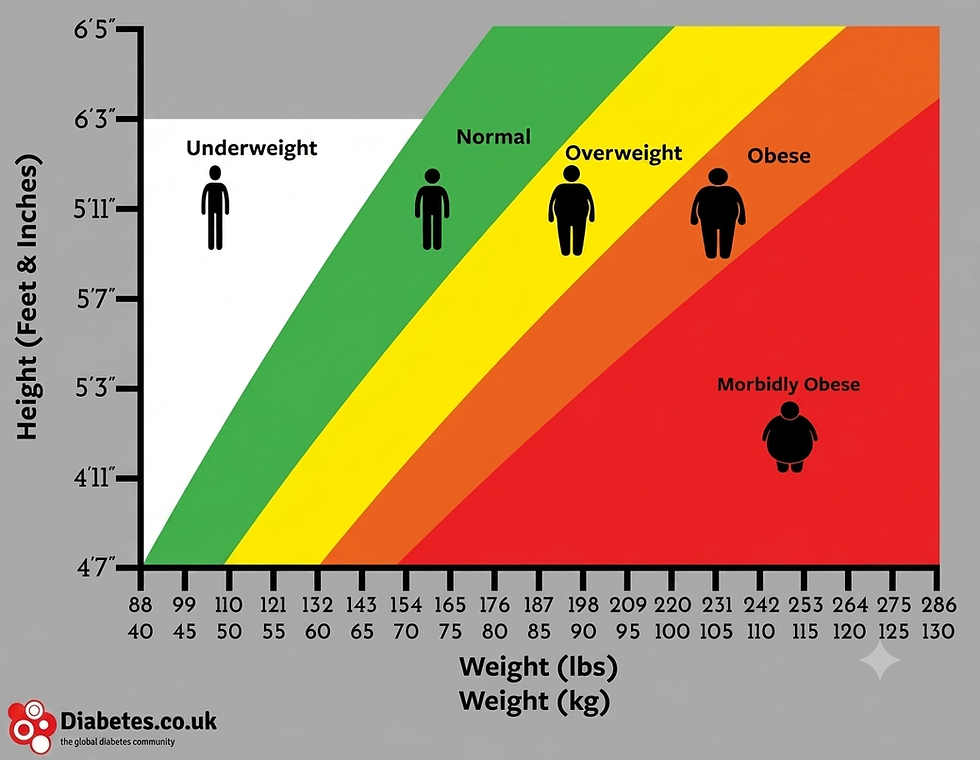
Understanding your Body Mass Index (BMI) helps gauge metabolic health risks.
Question 1: The BMI Baseline
Body Mass Index (BMI) is a common measure used to assess whether a person has a healthy weight relative to their height. However, the healthy BMI range varies depending on ethnicity due to differences in body composition and risk factors.
What is considered a "normal" or healthy BMI range for adults by ethnicity?
(Key: WC = White/Caucasian | BAME = Black, Asian and minority ethnic groups)
A) WC: 18.5 - 24.9 kg/m² | BAME: 18.5 - 22.9 kg/m²
B) WC: 20.0 - 26.9 kg/m² | BAME: 19.0 - 23.9 kg/m²
C) WC: 25.0 - 29.9 kg/m² | BAME: 23.0 - 27.5 kg/m²
D) WC: 15.0 - 18.4 kg/m² | BAME: 15.0 - 19.9 kg/m²
Question 2: The Fasting Fuel Check
Blood sugar levels are a key indicator of metabolic health. Fasting plasma glucose tests measure blood sugar after an overnight fast and help detect diabetes or prediabetes.
According to NHS guidelines, what is the normal range for a fasting plasma glucose test for a non-pregnant adult?
A) Under 3.5 mmol/L
B) Under 5.6 mmol/L
C) 5.6 - 6.9 mmol/L
D) Over 7.0 mmol/L
Question 3: The Waistline Warning
Where we store fat matters. For optimal metabolic health, an adult male's waist circumference should ideally be under 90 cm (approx. 36 inches). What should a woman's waist measurement ideally be under?
A) Under 70 cm
B) Under 80 cm
C) Under 90 cm
D) Under 102 cm
Question 4: The Home Blood Pressure Standard
When monitoring your blood pressure yourself at home (HBPM), what average reading is considered the upper threshold for "normal" before it is classified as high?
A) Less than 120/80mmHg
B) Less than 135/85mmHg
C) Less than 140/90mmHg
D) Less than 150/95mmHg
Question 5: The "Good" Cholesterol
HDL is known as "good" cholesterol because it helps clear fat from your arteries. What are the healthy target levels of HDL for UK adults?
A) Over 1.0mmol/L for men and over 1.2mmol/L for women
B) Under 2.0mmol/L for both men and women
C) Exactly 0.5 mmol/Lfor everyone
D) Over 3.0 mmol/L for men and over 3.5mmol/L for women
The NHS-Aligned Answer Key
1. A) WC: 18.5 - 24.9 kg/m² | BAME: 18.5 - 22.9 kg/m².
Knowing your BMI range helps identify whether you are at risk for metabolic issues such as insulin resistance or cardiovascular disease. For example, a BMI above the healthy range may indicate excess body fat, which can strain your metabolism.
NICE guidelines emphasise that individuals of South Asian, Chinese, Black African, and African-Caribbean descent have a higher risk of developing type 2 diabetes and cardiovascular disease at a lower BMI, meaning thresholds for health interventions are lower.
2. B) Under 5.6 mmol/L
NICE CKS states a normal fasting glucose is below 5.6 mmol/L.
A result between 5.6 and 6.9 mmol/L indicates pre-diabetes, and 7.0 mmol/L or above meets the threshold for a diabetes diagnosis and requires medical attention.
Maintaining blood sugar within the normal range supports steady energy levels and reduces the risk of complications like nerve damage or kidney failure.
3. B) Under 80 cm (approx. 31.5 inches).
Carrying excess weight around your middle is a strong indicator of visceral fat (fat around vital organs). The NHS notes that health risks increase significantly if a woman's waist is over 80 cm, or a man's is over 90 cm.
4. B) Less than 135/85mmHg.
While the standard clinic cutoff is 140/90 mmHg, NICE guidelines specify that normal Home Blood Pressure Monitoring (HBPM) should average below 135/85 mmHg to account for the relaxed home environment.
5. A) Over 1.0 mmol/L for men and over 1.2mmol/L for women.
Unlike other lipids, where lower is better, higher HDL numbers are cardioprotective. Falling below 1.0 mmol/L(men) or 1.2 mmol/L (women) is a key diagnostic marker for metabolic syndrome.
Drop a comment below: Which of these UK standards surprised you the most? Did you get 5/5? Let’s discuss!
What’s Your Next Step?
Take Control of Your Metabolic Health Today
Did your quiz results surprise you? Or perhaps you realise you don't actually know where your current blood sugar, blood pressure, or cholesterol levels stand.
You don't have to navigate these numbers alone. True metabolic health isn't about restrictive diets; it's about understanding what your unique body needs to thrive, boost energy, and prevent long-term illness.
Ready to get clarity?
Book a one-on-one Metabolic Health Consultation with me today. Together, we will look beyond the surface, decode your biomarkers, and build a personalised, realistic roadmap to optimise your numbers and reclaim your vitality.
Remember, metabolic health is not fixed. It can improve with consistent, healthy habits.
👉 [Book Your FREE One-on-One Metabolic Health Consultation Today]
Comments